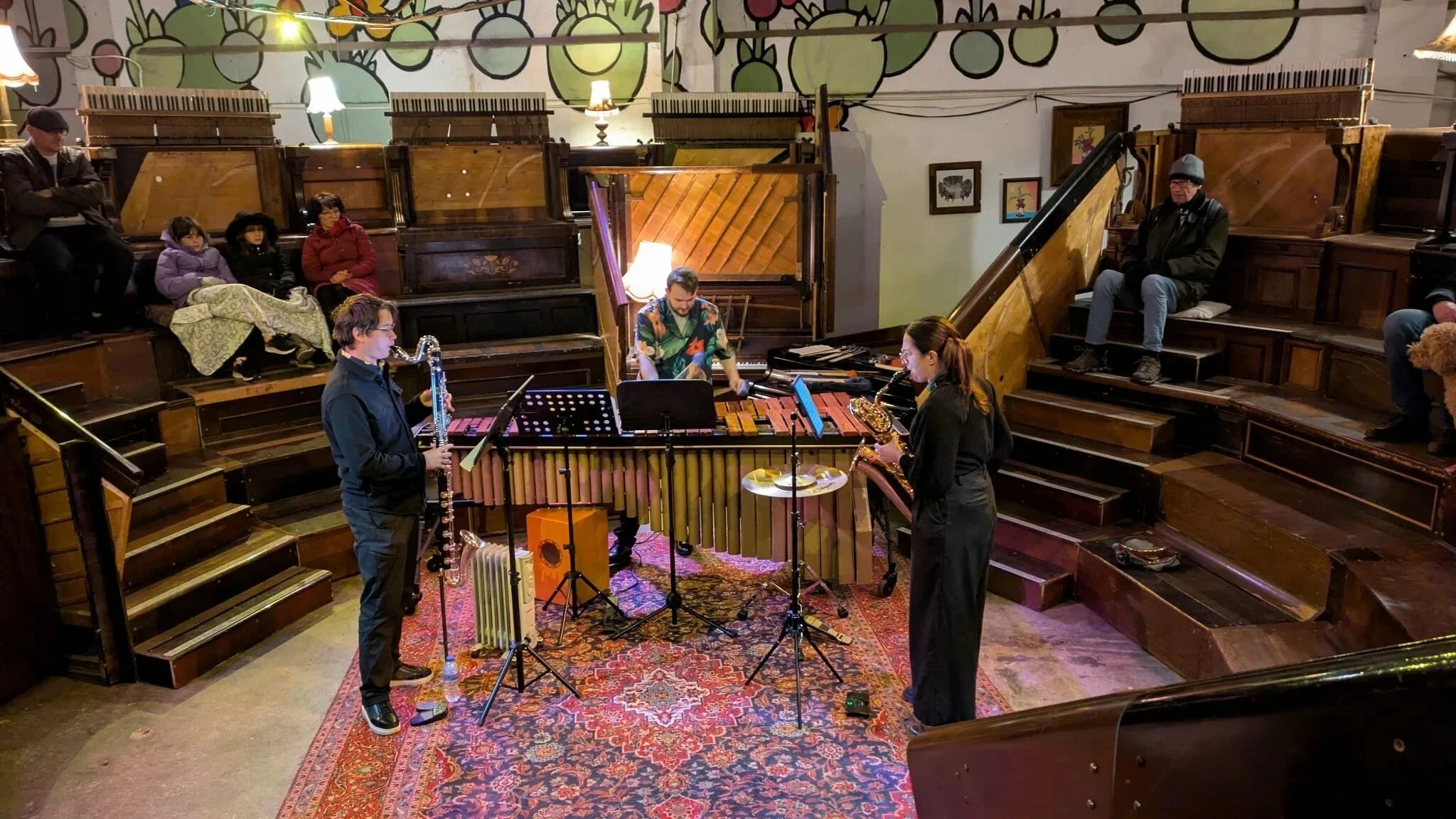
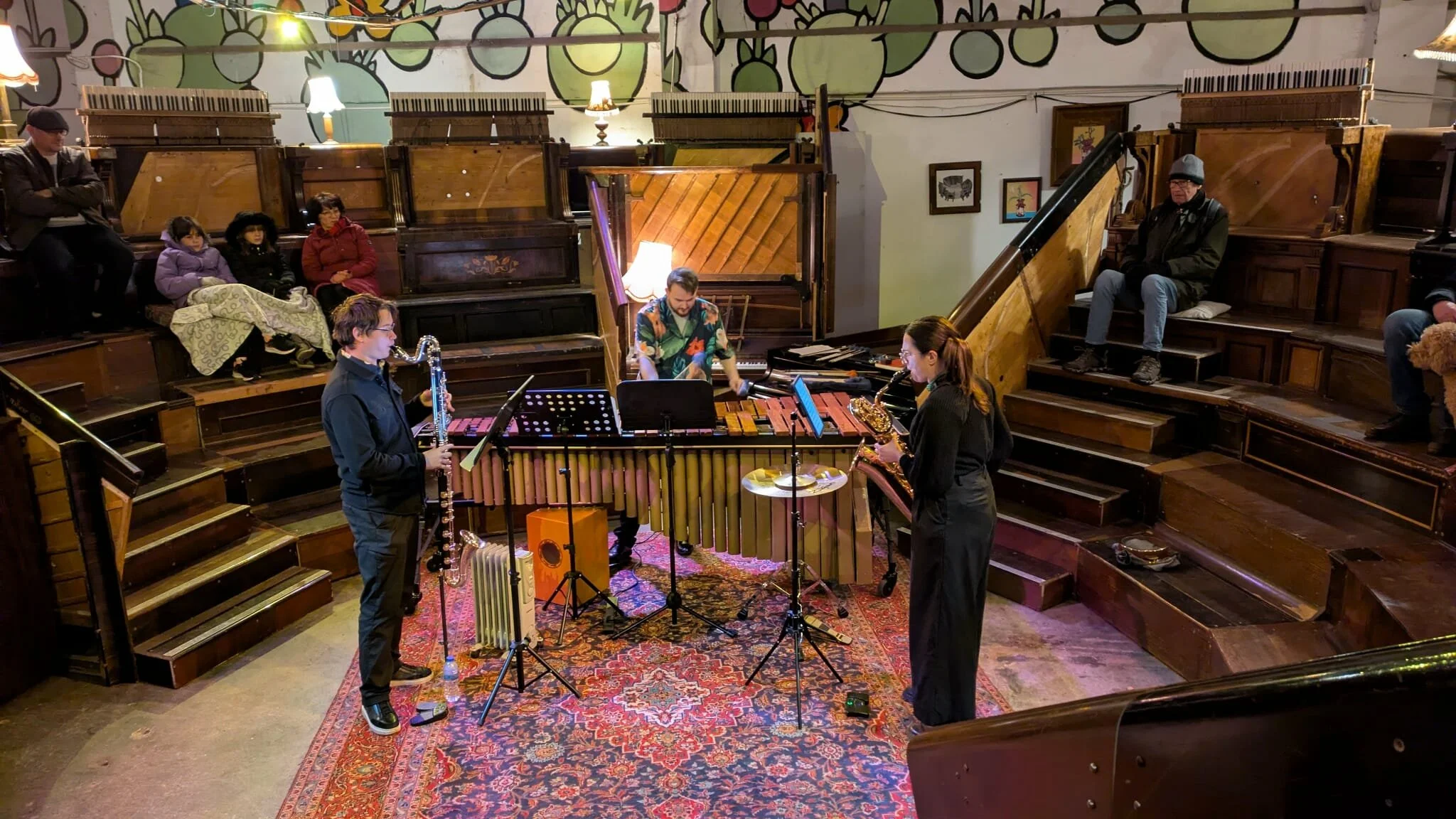
Thursday 27th November
Meldrum Academy, Oldmeldrum
Message For A Friend - Ney Rosauro
Pocket Grooves - Gene Koshinski
Brutals - Hannah McCoo
The Big Audition - Casey Cangelosi
Over The Rainbow - Harold Arlen arr. Robert Oetomo trans. Brodie McCash
Recitatives for Solo Saxophone - Stephen Morland
Neurodivergent - Sarah Lucas Page
Crowded In A Lonely Room - Brodie McCash
Resurreccion del Angel - Astor Piazzolla arr. Henry McNamara
McDOOT Scottish Tour 27th - 29th November 2025
Tour Set List
Friday 28th November
The Blue Lamp, Aberdeen
Message For A Friend - Ney Rosauro
Pocket Grooves - Gene Koshinski
Brutals - Hannah McCoo
The Big Audition - Casey Cangelosi
Theme and Phase Variations - Tim Tricker
Over The Rainbow - Harold Arlen arr. Robert Oetomo trans. Brodie McCash
Recitatives for Solo Saxophone - Stephen Morland
Neurodivergent - Sarah Lucas Page
Crowded In A Lonely Room - Brodie McCash
Resurreccion del Angel - Astor Piazzolla arr. Henry McNamara
Saturday 29th November
Pianodrome Granton, Edinburgh
Message For A Friend - Ney Rosauro
Pocket Grooves (Movements 2 & 4) - Gene Koshinski
Brutals - Hannah McCoo
Theme and Phase Variations - Tim Tricker
Over The Rainbow - Harold Arlen arr. Robert Oetomo trans. Brodie McCash
Crowded In A Lonely Room - Brodie McCash
Resurreccion del Angel - Astor Piazzolla arr. Henry McNamara
Programme Notes
Message To A Friend
Ney Rosauro
A unique and entertaining baiao written in 5/4, and in the style of Frank Zappa’s music. After the main themes there is open section of free improvisation for all players with accompanying stabs from the other players.
Pocket Grooves
Gene Koshinski
Joropo
Samai
Choro
Get It!
Pocket Grooves is designed with “small” in mind. The pieces are short and require small hand-held instruments for the percussionist while they also focus on simple harmony and simple melody. While these pieces present incredible challenges for the bassoonist, they are aesthetically light in nature and designed to celebrate three different traditional styles of music in the world (Joropo from Venezuela, Samai from the Middle East, and Choro from Brazil).
Pocket Grooves was written for bassoonist Jefferson Campbell as a request for a companion piece to Get It!, another work for bassoon and percussion by the same composer, in the same vein. Campbell asked for the same compositional approach here - a challenging work for the bassoon that stems from the “popular” music idiom and is accessible to a wide range of audiences.
The three movements in Pocket Grooves may be performed in any order and may be combined with Get It! to create a four-movement suite. In this case, all pieces should be considered movements of Pocket Grooves
Brutals
Hannah McCoo
Inspired by two brutalist structures in Sheffield, the Moore Street Electricity substation and the Arts Tower, this two piece movement attempts to look further into the architecture of these buildings, the feelings they evoke and how that can be transferred into a musical context.
Movement 1 Lines of the Substation
Designed in 1968, the concrete structure takes on more of a ‘physical influence’ through its structure with this movement. The entire building is made of large panels which are split horizontally into two sections with a large staircase running along the side of it. These panels have a symmetrical design of rectangular concrete slabs below one another. In the top section of the building there are six slabs per panel whereas the bottom section has eight slabs per panel and it is these numbers that influence how many times the main riff in this movement appears per section. Section A and its recapitulation showcase the riff and its variations 6 times in the bass clarinet part and 8 times in the baritone saxophone part until they finally come together in unison as for the concluding part of the movement. The piece is characterised as ‘tumbling,rushing’ to highlight the nature of the large staircase that runs alongside the building.
Movement 2 The Arts Tower Looms
The Arts Tower was opened to the public in 1965 and visually, is the complete opposite of the electricity substation. Its concrete foundation supports panes upon panes of glass windows and once was the tallest building in Sheffield. As mentioned before, the substation took on more of a physical influence with its structure whereas in this movement, the Arts Tower influence is through the emotions it evoked when I went to visit the building. It is no secret that the building is extremely large and when stood in front of it, can make anyone feel like the size of an ant. Movement two is an expression of my thoughts and feelings when I stood in front of the building and slowly lifted my gaze from the bottom to the very top of the building. Also, this movement is notably slower than the first in order to allow the player/listener to listen with contemplation.
Over The Rainbow
Harold Arlen, arr. Robert Oetomo, trans. Brodie McCash
As one of the most famous songs of all time, Over the Rainbow from The Wizard of Oz is a timeless treasure. In this arrangement for solo marimba, Robert Oetomo combines jazzy harmonies, quasi improvisation, and classical romantic influences to create a rendition that is mysterious, lyrical, and remains as heartwarming as the original.
Oetomo’s notation has meticulously spelled out the quasi improvisatory flourishes which leave much room for expressive interpretation and rubato. This piece is sure to be a rewarding musical experience to perform and to witness as a listener. This has been reworked to suit marimba and baritone saxophone by Brodie McCash to have both instruments sharing the melodic and accompaniment positions.
The Big Audition
Casey Cangelosi
Casey Cangelosi’s The Big Audition is a theatrical crash cymbal solo that blurs the line between concert performance and musical comedy. Conceived as a mock audition, the piece places the performer in the role of a highly strung percussionist desperate to impress an unseen panel, using humour, physical gesture, and exaggerated musical contrasts to tell the story.
The work moves rapidly between sharply defined styles and characters: exaggerated dynamic swells, awkward pauses, and moments of deliberate overconfidence or collapse. These contrasts are essential to the piece’s impact, as the music is inseparable from the performer’s acting. Facial expression, posture, timing, and stage presence are all integral, making The Big Audition as much a test of theatrical awareness as of technical control.
Despite its comedic surface, the piece demands precision and sophistication. Control of touch, articulation, and time are crucial, particularly in moments where silence and restraint are used for dramatic effect. Ultimately, The Big Audition satirises the pressure and absurdity of high-stakes performance situations, inviting the audience to laugh while recognising something uncomfortably familiar in the performer’s struggle for approval.
Recitatives for Solo Saxophone
(Prelude, Burlesque I, Lament, Burlesque II)
Stephen Morland
This four-movement unaccompanied work really allows the tone colours of the saxophone to sing. With a mixture of fast and slow sections, the piece creates an atmosphere of tension, excitement, and contrast. It also gives the musician a great deal of freedom to play the work in a way which makes each performance truly unique, in an exploration of tempo, dynamics, and extended techniques.
Neurodivergent
Sarah Lucas Page
In 2021, I was diagnosed with ADHD, I was 24 years old. I started having my first symptoms of ADHD when I was about five years old. I was always told I was the kid who was always daydreaming and never paying attention. As I got older and moved through middle school, high school, and college, I had to create different tactics to be able to go through my life as normal as possible. This caused me to develop other mental illnesses because of my ADHD being untreated. I composed this piece to explain my struggles through music to be able to better process my own emotions about it.
In the five sections of this piece I pull out the emotions I have been holding on to of anger, embarrassment, and shamefulness. Moving on through those emotions has been really difficult for me. Through the music I push all those emotions out with loud and aggressive motifs then quickly move to beautiful soft sections to show the opposite side of myself and how I am working through it.
The entire piece as well plays on the humour of ADHD/ADD. Quickly moving from one section to highlight the consistent forgetfulness, day-dreamy, and distracted way of people who have this neurodiversity.
Crowded In A Lonely Room
Brodie McCash
This piece had been written for the trio McDOOT however on the journey and composition Brodie realised its potential as a solo marimba work also. The marimba solo version had been performed in Brodie’s recital at the Bon Accord Baths in October this year and he is very pleased to be able to perform the full work with McDOOT.
Through the chordal progression at the start, Brodie intends to take you on an emotional hourney with moments of light, dark and serenity. The title came from a piece of creative writing he had written in high school (many years ago) called: “Lonely In A Crowded Room,” a story about feeling isolated amongst the chaos and madness of school. As he had grown older he felt it appropriate to move the title as it is more frequent for him to be very busy in his mind only to look up and see there is calmness around him.
The piece develops through a kind of feebleness to start, works through to a more open joyous experience before retreating to the original themes.
Resurrección del Ángel
Piazzolla arr. McNamara
This tango is the final work in Astor Piazzolla’s “Angel” suite. Following his studies with Nadia Boulanger in Paris, Piazzolla wrote a number of experimental tangos including “La Muerte del Ángel”. “Introducción del Ángel” and “Milonga del Ángel” were later written to complement “Muerte” for the 1962 tango opera “Tango del Ángel”. The opera is originally a tragedy, but Piazzolla later added “Resurrección” in 1965 to give the suite a happy ending. In this arrangement, strains of the melodies from the other three works in the suite can be heard, in reverse order; first “La Muerte”, as the angel must first die to be resurrected, then “Milonga” as the angel dances through the underworld, and finally “Introducción” as the angel is reborn and reintroduced to the world.